
Where mood, hormones, and lifestyle meet
You are not “being difficult.” PMDD follows a pattern.
Evaluation, diagnosis, and treatment of premenstrual dysphoric disorder for women in Florida and Maryland.
If you feel like a different person for one or two weeks of every month and then watch that feeling lift within a day or two of your period starting, you are describing timing, not temperament.

Premenstrual dysphoric disorder is a cyclical mood condition tied to the second half of the menstrual cycle. It is generally understood as an increased sensitivity to the normal cyclical hormonal changes that follow ovulation, rather than a hormone imbalance. Most women with PMDD have hormone levels in the normal range, and normal levels do not rule PMDD out.
That distinction matters, because it changes what actually helps. That is why normal hormone levels do not rule PMDD out, and why evaluation focuses on the symptom pattern rather than assuming a hormone imbalance. Understanding the pattern helps guide treatment toward the symptoms, timing, and individual factors that matter most.
The shape of a PMDD month
What PMDD looks like across a cycle
Symptoms emerge or intensify in the second half of the cycle, are usually at their worst in the late luteal days before your period, and improve once menstruation begins.
Recognition
Could it be PMDD?
These are the symptoms women most often describe. You do not need all of them, and you do not need the most severe version of any of them. A diagnosis generally requires at least five symptoms in the week before your period, including at least one of the mood symptoms below, with meaningful effect on work, school, relationships, or daily life.
- Marked irritability or anger
- Sudden sadness or tearfulness
- Anxiety or feeling overwhelmed
- Mood swings
- Difficulty concentrating
- Low energy
- Changes in sleep or appetite
- Feeling unlike yourself before your period
- Meaningful interference with work, relationships, or daily functioning
The pattern matters as much as the symptoms.
Any one of these can happen for all kinds of reasons. What points toward PMDD is when they arrive at the same point in your cycle, month after month, and then ease once your period starts.
When it goes deeper than low mood
For some women, the premenstrual phase brings severe hopelessness or thoughts of self-harm. This is a recognized part of PMDD, and it is treatable.
Call or text 988, the Suicide & Crisis Lifeline, any time, day or night.
You do not need to wait for the phase to pass or for your next appointment. You can also call 911 or go to your nearest emergency room. And please tell us, because it changes what we recommend and how quickly we move.
An important distinction
PMS, PMDD, and PME are not the same thing
Three different patterns get called “PMS” in everyday conversation. Telling them apart is one of the most useful things an evaluation can do, because each one points toward different treatment.
PMS
Premenstrual syndrome
Physical and emotional symptoms in the days before your period can include bloating, tenderness, moodiness, and irritability. PMS is common and real. Symptoms are generally less severe than PMDD, but they can still affect mood, comfort, and daily functioning.
Symptoms are generally less severe than PMDD, although PMS can still affect daily functioning.
PMDD
Premenstrual dysphoric disorder
PMDD involves more severe cyclical mood and related symptoms with meaningful impairment and a clearer on-off pattern. Symptoms appear in the second half of the cycle, worsen before your period, and lift after it begins. This leaves a stretch of the month when you may feel more like yourself again.
More severe and genuinely impairing, with symptoms lifting after the period begins.
PME
Premenstrual exacerbation
An underlying condition, such as depression, anxiety, or ADHD, is present during the rest of the month but becomes noticeably worse premenstrually. Symptoms may ease after menstruation begins, but the underlying condition remains present at other times in the month. PME is a clinical pattern rather than a separate DSM diagnosis.
Present all month, and worse in the days before your period.
This is why we ask about the whole month, not only the difficult weeks. PMDD and PME can feel almost identical in the days before a period. What separates them is what the rest of the cycle looks like, and that difference changes the treatment plan.
How we get to an answer
What evaluation may include
PMDD is diagnosed through the clinical pattern and prospective symptom tracking. There is no blood test that confirms it. Laboratory testing has a different job here: it is used when clinically appropriate to look at other possible contributors or conditions, not to diagnose PMDD.
Menstrual-cycle and symptom history
When symptoms start, how long they last, how severe they get, where they sit relative to your period, and how they affect your work, home life, and relationships.
Psychiatric history
What has been present over time, and whether something is running underneath the cycle rather than only alongside it.
Medication and substance review
Including anything that may be shaping mood, sleep, or the cycle itself.
Prospective daily symptom tracking
Daily ratings across at least two symptomatic cycles. This is the standard for confirming the PMDD pattern because looking back from memory is not reliable enough. Tracking also gives you a map of your own cycle.
A structured daily rating tool
When clinically appropriate, we use the Daily Record of Severity of Problems (DRSP), a short daily symptom record.
Distinguishing PMDD from PMS and PME
One of the most important distinctions in the evaluation is whether the pattern fits PMDD, PMS, or PME, which is why tracking covers the entire cycle rather than only the difficult days.
Evaluation of medical contributors when clinically indicated
Evaluation also considers possible medical contributors when your history suggests a need. Laboratory testing is individualized and is not routinely required to diagnose PMDD.
Safety and risk
We ask directly about hopelessness and thoughts of self-harm, because for some women these come with the premenstrual phase. It changes what we recommend and how quickly.
When the history strongly suggests PMDD, treatment and symptom support may begin while prospective tracking continues to clarify and confirm the pattern.
Treatment
How PMDD is treated
One unusual feature of PMDD treatment is that some medication approaches can be timed to the menstrual cycle rather than taken continuously. That opens options, and it also means there is no single right plan. What we recommend depends on your symptoms, your cycle, anything else being treated, and what you want. We revisit the plan as those change.
Whole-person care
PMDD care and the Balanced Mind Framework™
Lifestyle factors do not cause PMDD. The Balanced Mind Framework™ is used to support symptom management and overall mental health alongside evidence-based psychiatric care; it does not replace indicated medication or other treatment.
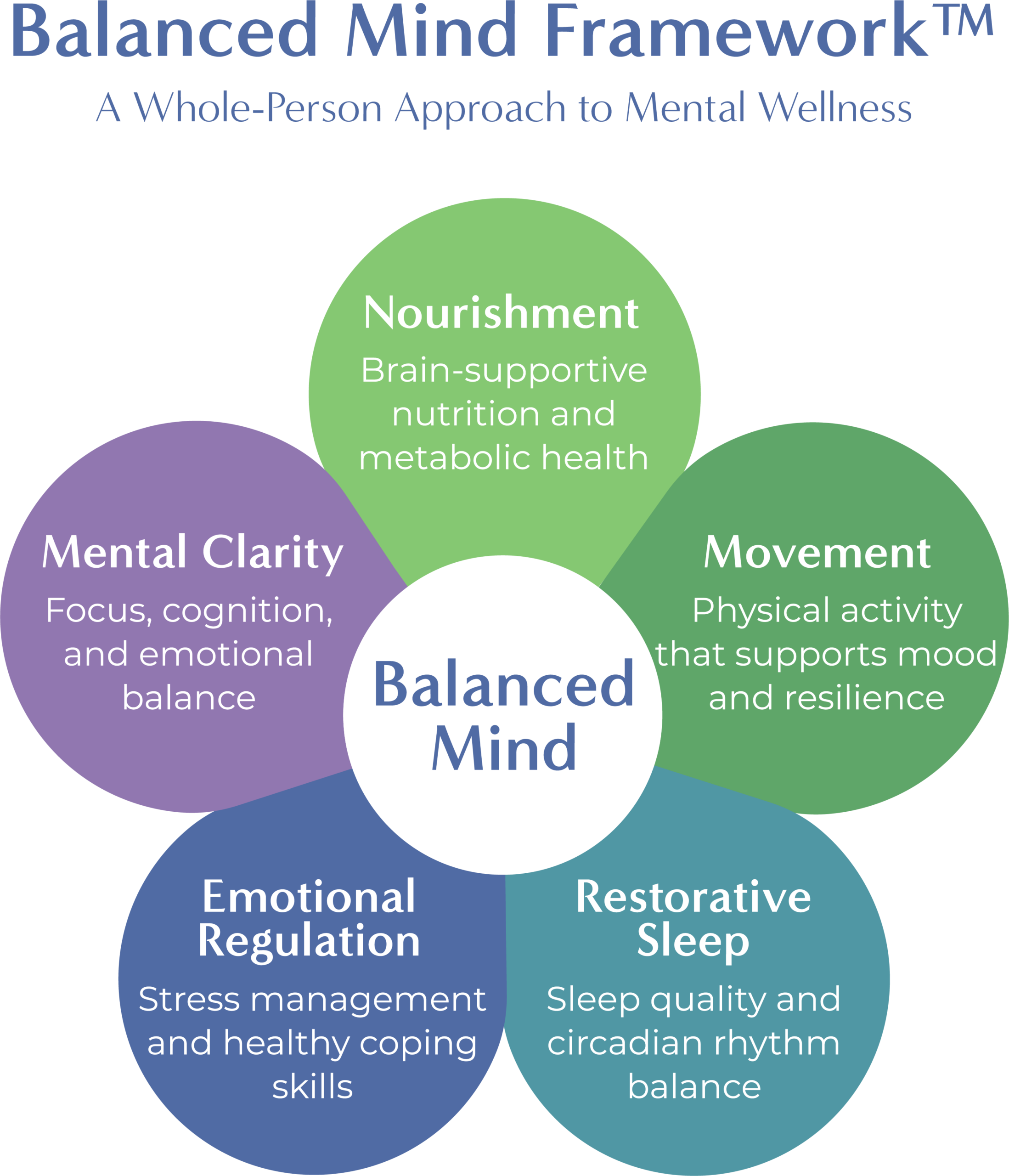
Five elements, one for each petal.
Nourishment
Supporting regular eating, including before your period when appetite and cravings may change. Nutrition-focused support may be provided as part of psychiatric care and is not offered as a stand-alone service.
Movement
Adapting physical activity to your symptoms, energy, and preferences across the cycle.
Restorative Sleep
Supporting consistent sleep routines and addressing sleep difficulties when they occur across the cycle.
Emotional Regulation
Practical coping strategies for difficult days, informed by your own symptom pattern.
Mental Clarity
Where practical, planning demanding work, conversations and decisions with your symptom pattern in mind.
Knowing your own pattern is itself a tool. Your needs may change across the cycle, and adapting support to those changes is part of care.
Working together
When other clinicians may be involved
PMDD sits where psychiatry, women’s health and daily life overlap, so good care often involves more than one clinician. Depending on your situation, that may include any of the following. We are comfortable being one part of a team rather than the whole of it.
Gynecology and women’s health
For hormonal treatment, contraceptive management, and cycle-related questions that belong in women’s health.
Primary care
For general medical care and evaluation of possible medical contributors when your history suggests a need.
Psychotherapy
For the ongoing therapy work that sits alongside psychiatric care. If you are not already working with a therapist, we can help you explore referral options.
Registered dietitian
For nutrition work that goes beyond the nutrition-focused support provided within psychiatric care.
Other specialists
Endocrinology, sleep medicine, or other clinicians involved in your care, when coordination is relevant to your symptoms or treatment.
With your permission, we coordinate with other clinicians involved in your care to help keep information and treatment plans connected.
Start here
If the pattern on this page looks like your month, that is worth an evaluation. New patients begin with a full visit covering your history, your cycle, and what has already been tried.
New Patient? Start HereIf you are in crisis or thinking about harming yourself, call or text 988, the Suicide & Crisis Lifeline. If you are in immediate danger, call 911 or go to your nearest emergency room. Balanced Mind Mental Health is an outpatient telehealth practice and does not provide emergency services. Click here for crisis resources.